For young executives and account executives
You're good at your job. Presenting is the only thing holding you back.
You volunteer for the spreadsheet so someone else can do the talking. You
skip the big pitch, pass on the stage, and tell yourself next time. Show Up,
Speak Up, Stand Up, Show Off is a short, practical course that gives you four
moves to walk into your next presentation ready, for just $27.
One-time payment. Start this week.
Who's teaching you
I'm Benjamin Oxley.
I've performed for a Sultan, was invited and performed with the Berlin Philharmonic under Claudio Abbado several times, and sung for the famous actress Elizabeth Taylor at the Royal Albert Hall. I've felt the fear you feel before a room goes quiet and every face turns towards you. I now judge music competitions and coach executives, and here's what I've learned: confidence isn't a personality trait. It's a routine.

YOU ALREADY KNOW THIS FEELING
Same fear, two different offices.

Emily, Corporate Executive, 25, Sydney
You're organised, you prepare, and you care about your team. Then a senior leader asks you to take the room through your plan and your chest tightens.
You suggest a colleague presents instead and tell yourself it's good
delegation.
Meanwhile someone less prepared speaks first, gets the credit, and gets noticed. You had the better idea. They hadź the better first sentence.

Jack, Account Executive, 25, Melbourne
You're great one to one: coffee, chat, easy rapport. But a formal pitch to a boardroom of strangers is different. Your mind races, your voice goes flat, and you hand the big presentation to a senior colleague so you don't "get in the way".
The accounts you want are decided in rooms you keep stepping out of. Every pitch you pass on is a promotion someone else collects.
What avoiding it costs
This is where most people get it wrong: they think avoiding a presentation is free. It isn't.
Your peers see the wrong version of you. Quiet and safe, not capable
Promotions go to the visible. Leaders remember the people who
presented.
The story at home stays the same. You give the polite answer because
you can't yet point to the moment you owned the room.
You feel it in private. The replaying, the "I should have said
something", the dread when a calendar invite lands.


Picture the other version
Let me give you an example. You are invited to give a big presentation. You feel a little nervous and a lot ready. You walk in, say your first sentence the
way you rehearsed it, and the room leans in.
Afterwards a colleague says, "I didn't know you could do that." A senior
person asks you to present again. You phone home and, for once, you have something specific to tell them.
That version of you doesn't need to be someone else. Here's what actually matters: you need four small habits.
What it is
WHAT YOU'LL LEARN
There are three things you get from this course: four moves you can practise one at a time, a short drill for each, and a clear next step when you finish. Let's break this down.
1
Show up
Walk in ready instead of hoping. A simple entry routine for the first ten seconds.
2
Speak Up
Open early and clearly. Reset your nerves in 90 seconds and say your point once.
3
Stand Up
Stay steady when you're challenged. Answer the hard question without rushing or retreating.
4
Show Off
Make your results visible without cringing, so the right people see what you do.
The short version
If you remember one thing: you don't need to become a different person. You need a routine for the moments that scare you.
Why this matters
Here's why this matters to you.
With your peers: you stop being "the quiet one who does great work" and
become the person people want in the room.
With your family: relatives who wonder if you're really going places respond
to what they can see. A confident presentation gives you something real to
tell them.
With yourself: the best result is private. You stop dreading the calendar invite,
stop replaying meetings, and start to trust you can handle it.
The short version
The main point is this: confidence isn't a feeling you wait for. It's what you build by practising small moves until they're yours.
WHAT'S INSIDE FOR $27
The four steps, taught one at a time
A short practice for each, ready to use before your next meeting or call
Guidance for presenting to senior leaders and to clients
A clear next step when you finish: From Doubt to Know
Plus bonuses you can use!
Try it risk-free
[Confirm your policy.] Try the first move before your next meeting. If it doesn't help, email [email protected] within [30] days for a full refund.
Is this for you?
This is for you if you're early in your career, you do good work, and presenting is the thing standing between you and the next role.
This isn't for you if you want to become a keynote speaker overnight, or you want a magic trick that removes nerves entirely. Nerves don't disappear. You learn to work with them.
Questions
I'm terrified. Is this for me?
Yes. It's built for exactly that. Each move is small.
How long does it take?
[It takes 21 days to build a habit. We take 30 days so you live the change.]
Is it only for presenting?
It's built around presenting, but the same moves help in meetings, pitches and tough conversations.
Start Here
Start for less than the cost of lunch. Here's what we need to do next: you take the first step, try the first move before your next meeting, and see what changes.
$27 · one-time payment
Benjamin Oxley, The Confidence Academy
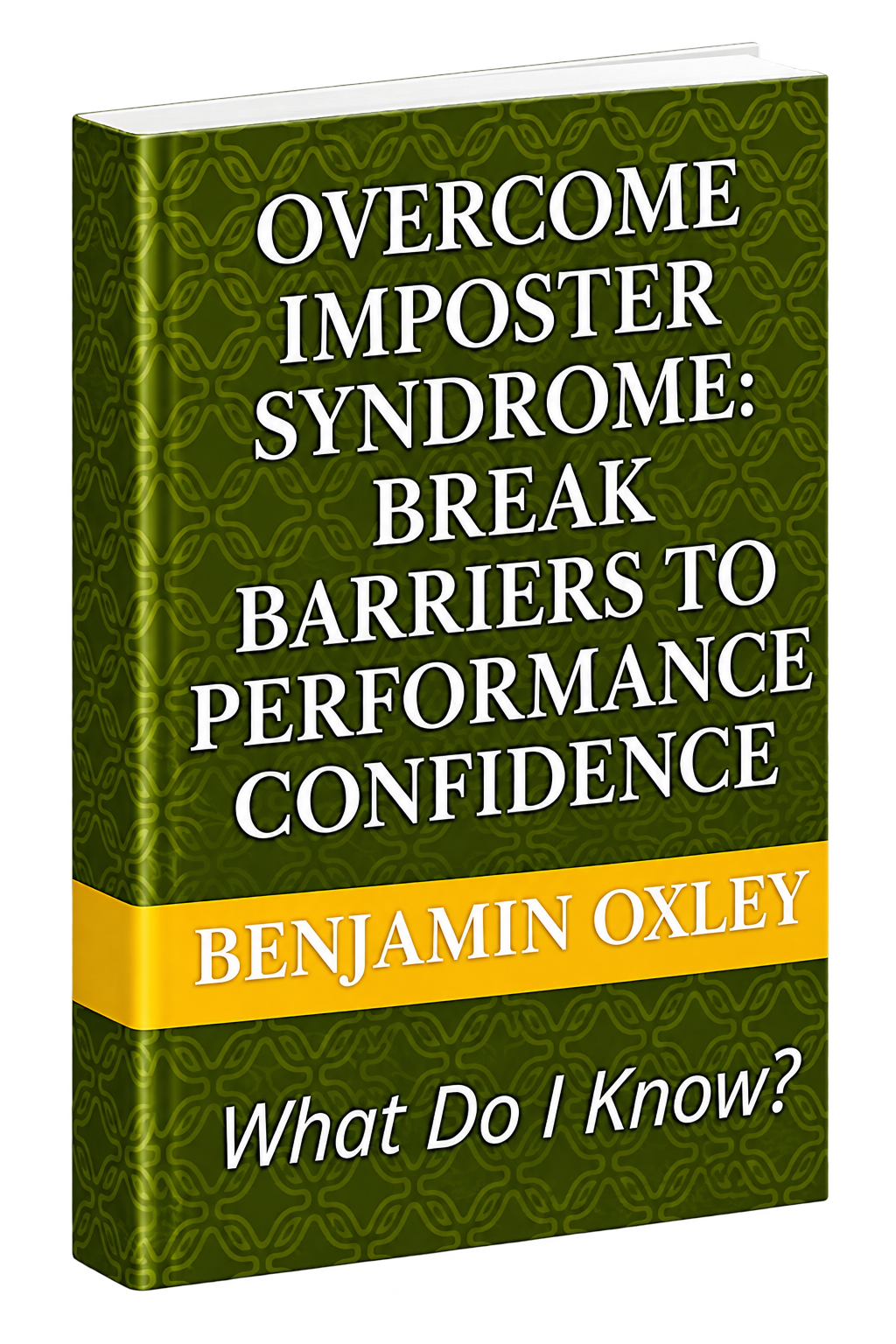
OVERCOME IMPOSTER SYNDROME
Break Barriers to Performance Confidence: What Do I Know?
This book aims to help individuals overcome performance anxiety and imposter syndrome. It emphasises that most performers experience nerves and fear, but the key is to manage these feelings and focus on the audience’s needs. The book highlights the importance of courage, action, and learning from mistakes, rather than seeking perfection or eliminating fear entirely.
Confidence is built through self-awareness and understanding one’s strengths, weaknesses, and past experiences. Conducting a self-survey, reflecting on past outcomes, and setting direction based on personal knowledge are essential steps in this process. Regular reflection, journaling, and using tools like mind maps can aid in gaining clarity and building confidence.
The 3 Cs - Clarity, Consistency & Courage - are essential for personal growth. Clarity involves understanding your values and setting goals, Consistency focuses on building good habits and routines, and Courage encourages taking action despite fear. The programme guides participants through activities and reflections to develop these skills, culminating in a final task of sharing their progress with a partner.
Real life examples of failure, imposter syndrome and overcoming stage fright and performance anxiety are included in this book. You failed? Good. This book is for you, or anyone who wants to perform with confidence.
The text outlines a programme for personal growth and transformation. It includes activities like reviewing principles, writing a transformation story, and celebrating progress. The programme also covers topics like overcoming imposter syndrome, building confidence, and integrating one’s shadow.
To break a habit, focus on changing behaviour rather than just positive affirmations. Preoccupy your brain with new actions to counteract automatic, unhelpful habits. Reducing stress, building a supportive network, and practising self-compassion are also crucial for successful habit change.

Copyright © 2026 The Confidence Academy AUS, All rights reserved.
Privacy Policy | Terms of Service